I am a network engineer. Since you are reading this lesson, you are most likely a network engineer too.
Network engineers have one thing in common: they don't want to switch professions, especially to become software or platform engineers.
So as long as this profession exists, we network engineers will be network engineers. And I believe networking will exist long after AI disrupts most of IT. Why? Because the network sits at the crossing point of multiple IT domains:
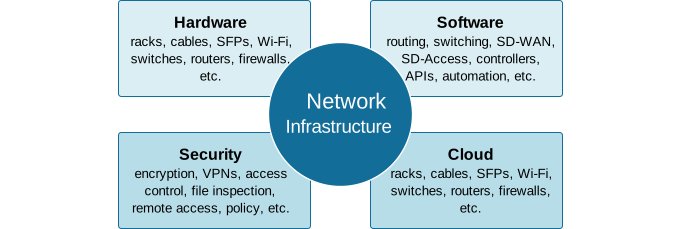
- It touches hardware: racks, cables, SFP modules, Wi-Fi, switches, routers, and firewalls.
- It touches software: routing protocols, switching protocols, SD-WAN, SD-Access, controllers, APIs, and automation platforms.
- It touches security: encryption, VPNs, access control, file inspection, remote access, and policy.
- It also touches cloud, containers, identity, monitoring, and operations.
- And it is also one of the basic ingredients of governance and sovereignty.
For me, the network is like a country’s road system. There are many vehicle brands and models. Cars, trucks, buses, and motorcycles are all different. But once they use the road, they must follow the same rules.
The road infrastructure enforces order.
The network plays the same role in an organization. There will be users, applications, containers, AI workloads, and AI agents. They may all be different. But once they communicate, they must follow the organization’s rules. Who can talk to whom? Which traffic is allowed? What must be encrypted, inspected, blocked, or logged?
This is why the network is more than connectivity. It is where policy, security, visibility, governance, and sovereignty take place.
So I cannot imagine a world where AI agents handle everything on their own. Who will rack the equipment? Who will replace a failed SFP? Who will trace a cable? Who will understand the business risk behind a network change?
Why should we learn Python?
AI will change networking. No doubt.
But it will not remove the need for people who understand networks deeply.
I am a CCIE Routing and Switching, now called CCIE Enterprise. For many years, I wondered which track I should study next to upgrade my career.
Data Center?
Security?
Wireless?
Service Provider?
I spent time with all of them. And they are all valuable. Each one makes you a stronger network engineer. Each one gives you deeper and broader knowledge.
But at some point, I realized something important.
Most other CCNP and CCIE tracks make you a better network engineer.
Automation changes your profile.
That is different.
CCNP or CCIE Automation does not simply add another topic to your skill set. It changes the way you think. You are no longer only a network engineer. You become a network engineer who can also think like a software engineer.
And that is a major career shift.
A traditional network engineer usually works with the tools that vendors provide. With Cisco devices, for example, you use the CLI. You check the configuration. You troubleshoot the issue. You make a change. Then you verify the result.
This skill is still important. It will remain important.
But automation adds a new layer on top of it.
Instead of using only the vendor’s tools, you can build your own tools.
Instead of checking devices one by one, you can collect data from many devices at once.
Instead of troubleshooting only with commands, you can stream telemetry, analyze data, and create automatic checks.
Instead of making changes by hand, you can use templates, APIs, workflows, and validation logic.
And that changes everything.
You stop thinking only in terms of commands.
You start thinking in terms of systems.
You start asking different questions.
What data do I need?
Where can I get it from?
How can I validate it?
How can I repeat this process safely?
How can I prove that the network is working as expected?
That is the real value of automation.
Automation is not just another networking topic. It changes how you deploy. It changes how you troubleshoot. It changes how you document. It changes how you scale your work.
A network engineer with automation skills is not a replacement for traditional networking knowledge.
He is a force multiplier.
The deeper your networking knowledge is, the more powerful your automation becomes. And the better your automation skills are, the more value you can extract from your networking knowledge.
That is why automation is not just about Python.
It is not just about APIs.
It is not just about tools.
It is about a new way of thinking about networks.
Full Content Access is for Subscribed Users Only...
- Learn any CCNA, CCIE or Network Automation topic with animated explanation.
- We focus on simplicity. Networking tutorials and examples written in simple, understandable language.